
Blog
The Rise of Automotive Industries — Historical Background of the Automobile

The United States emerged as a dominant force during this period, led by companies such as Ford, General Motors, and Chrysler. Mass production techniques enabled American manufacturers to produce vehicles at unprecedented speed and scale. Meanwhile, Europe played a crucial role in engineering excellence, with Germany, France, and Britain developing technologically advanced automobiles focused on performance, durability, and design innovation.
Automobile factories rapidly expanded, becoming symbols of industrial power. Large production plants employed thousands of workers, integrating assembly lines, heavy machinery, and standardized manufacturing systems. This industrial growth also stimulated related sectors such as steel, rubber, glass, and petroleum, creating a vast economic ecosystem around automobile production.
As competition intensified, manufacturers invested in research and development, leading to improvements in engine efficiency, safety features, and vehicle comfort. International trade further accelerated the industry’s expansion, allowing automobiles to be exported across continents.
The rise of automotive industries did more than produce cars — it reshaped global labor markets, urban development, infrastructure planning, and consumer culture. By establishing automobiles as mass-produced industrial products, this era solidified the foundation for the modern global transportation economy.
#QSpeedyAutoGarage #AutoGarageQatar #CarRepairExperts #AutomotiveService #GarageLife #DriveWithConfidence
Recent Posts

This diagram explains how a car engine controls and reduces harmful emissions. It shows the flow of air, fuel, and exhaust gases, along with key components like sensors, catalytic converter, and ECU working together to improve engine performance and protect the environment.
Read more
The history of the automobile engine is a story of innovation, experimentation, and constant improvement. From early steam-powered machines to today’s high-efficiency hybrid and electric systems, engine development has shaped the modern world.
Read more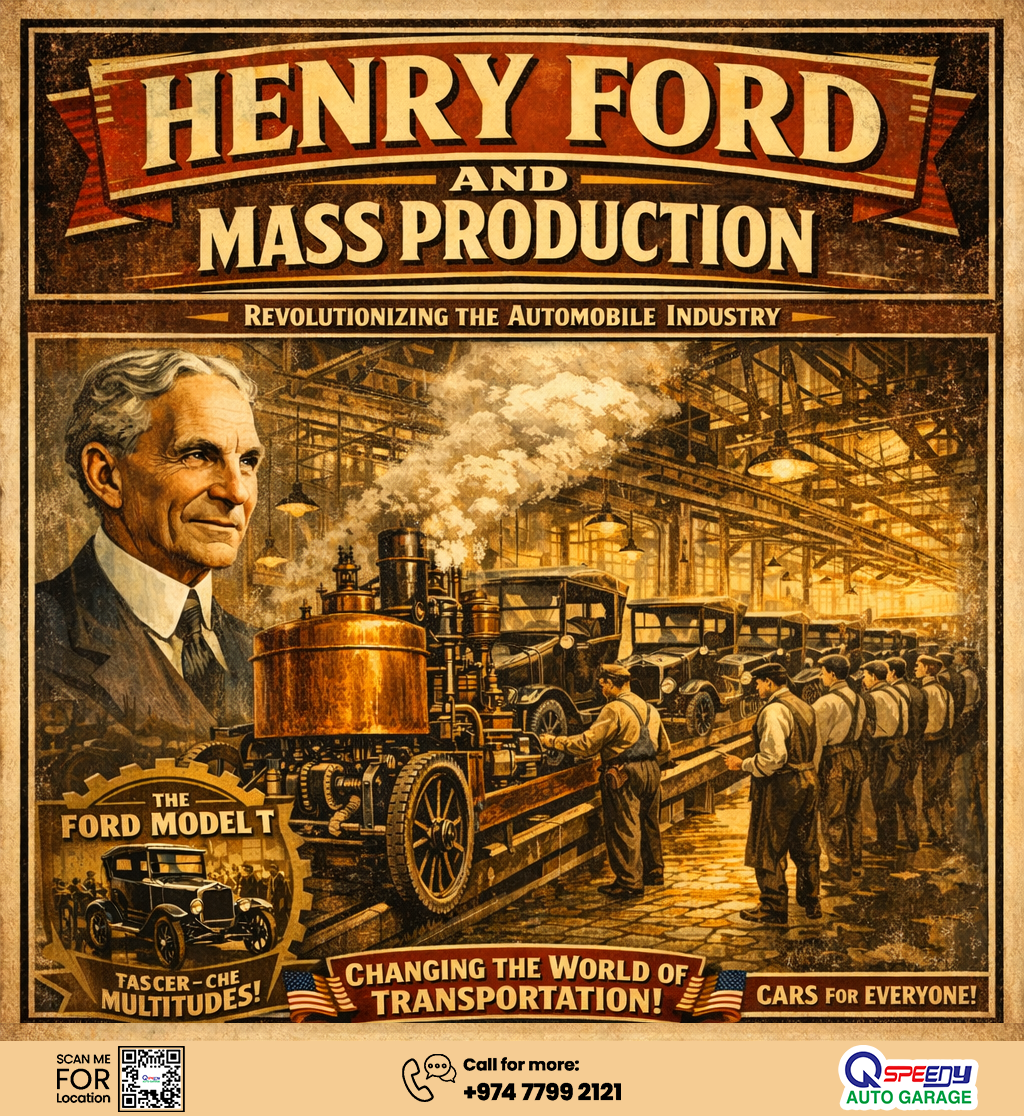
The history of the automobile reached a turning point with the revolutionary vision of Henry Ford, an American industrialist who transformed cars from luxury inventions into everyday necessities. Before Ford’s innovation, automobiles were handcrafted, expensive, and accessible only to the wealthy. Production was slow, and each vehicle required extensive manual labor by skilled workers.
Read more
The period between 1900 and 1930 changed the automobile industry forever. During this time, mass production made cars affordable and accessible to ordinary people, not just the wealthy.
Read more
From ancient tools to modern machines, the engine has been one of the most transformative inventions in human history. It represents humanity’s constant pursuit of efficiency, power, and progress.
Read more